A Personal Testimony of Spiritual Confusion, Abuse, and Grace
This testimony reflects one woman’s lived experience, perceptions, and spiritual understanding of events as she experienced them. It is shared to bear witness, not to accuse, and represents her personal truth.
There is a particular kind of disorientation that comes when language meant to give life is experienced as something that wounds instead. When Scripture that once felt comforting becomes a source of fear and confusion. When the name of Jesus is spoken often — and yet, the impact on the soul feels crushing rather than healing.
This is how spiritual abuse unfolded in Sarah’s life, as she experienced it.
When God’s Words Get Twisted
Sarah was in the relationship for five years. Five years of believing, praying, waiting, and hoping that the man she loved — Robert — whose words about God were passionate and articulate, would eventually live in alignment with what he preached.
From Sarah’s perspective, Robert quoted Scripture fluently and often spoke about God’s love, demons, and deliverance with a confidence that suggested special insight. At times, he described Sarah as a gift, a partner, a best friend — even an angel sent to open his eyes. He once wove those words into a song he shared privately with her.
Over time, that language shifted.
Sarah experienced herself being redefined — no longer as a gift, but as a problem. She recalls being described as deceptive, untrustworthy, seductive, even spiritually dangerous. At one point, Robert attempted to cast what he described as a “spirit of seduction” out of her.
At the same time, Sarah discovered information that deeply disturbed her. In her understanding, she found evidence suggesting he was seeking sexual services at massage establishments, searching explicit terms online, and engaging in hidden conversations with other women — while accusing her of infidelity.
Sarah was not passive in this process. She recalls finding messages, search histories, and eventually encountering him at a massage establishment. To her, these discoveries formed a consistent pattern that contradicted what she was being told.
Still, she stayed — not because she felt weak, but because the truth was often wrapped in charm, spiritual language, and hope. She believed in growth, grace, and accountability. She also recognized that she had her own areas of growth. Eventually, she came to see that her repeated willingness to return was itself part of the cycle.
What made it especially confusing was that at times, Robert appeared to want healing. He prayed. He spoke about change. He attended counseling sessions with her. His words about God often sounded sincere. Somewhere in the process, Sarah realized she had begun to lose clarity about where God’s voice ended and his began.
The Hope That Kept Her There
As Sarah began creating distance, she noticed changes within herself. Her awareness sharpened. She began to believe that what she was experiencing was not only emotional, but spiritual.
During one separation, she recalls seeing what appeared to her as a dark silhouette in her hallway late at night. She dismissed it, laughed at herself, and assumed it was stress or imagination.
She returned to the relationship.
Months later, after another period of separation, she experienced something similar again — this time on a pier, sensing a dark presence behind her. Once again, charm and confusion followed. Robert told her she was all he needed. He emphasized closeness, even sharing another song he had written.
When apologies came, they often felt vague to her — expressions of regret without naming specific harm. Without clarity or repair, the cycle resumed. Eventually, Sarah reached a point where she felt she could no longer continue. She left, believing it was final.
Her body, however, carried the weight. She experienced intense physical symptoms — difficulty breathing while lying down, chest pain radiating down her arm, and eventually a panic attack so severe she believed she might be dying. Unable to move or call for help, she prayed, focusing on her son’s safety.
Using grounding techniques a friend had once shared, she slowly returned to the present moment.
That night, as she slept, Sarah experienced what she understood as another spiritual encounter — a smoky presence, a sense of threat, and intense fear. She woke herself up, prayed, and eventually fell asleep again.
Looking back, Sarah believes that spiritually confusing and abusive relationships can leave people vulnerable — especially when Scripture is used to distort reality and intimacy is mixed with fear. In her understanding, darkness often imitates light.
Sleep Paralysis — and the Light That Saved Her
The next day, exhausted, Sarah laid down to rest, sensing something would happen again.
She experienced what she recognized as sleep paralysis — something she had encountered once in her early twenties after experimenting briefly with lucid dreaming. This episode felt more intense. She perceived darkness, overwhelming noise, physical paralysis, and fear. She could not tell whether she was dreaming or awake.
Then, instead of fighting, she cried out to Jesus.
In her experience, everything changed instantly. She perceived an overwhelming burst of light. The presence she felt was gone. She woke feeling lighter than she had in years.
For Sarah, this was not symbolic. It was real. Jesus saved her.
Wanting to Share — and the Final Break
Sarah remained intermittently in contact with Robert and felt a desire to share what had happened — the freedom she experienced, the encounter with Jesus, and the hope that healing was possible.
At the same time, she observed that while she was struggling with anxiety and recovery, Robert was publicly active — performing gospel music, praying over strangers, sharing stories of spiritual impact. When he spoke to her, he spoke about these things enthusiastically, but did not ask how she was or acknowledge what had happened between them.
When she tried to share her experience, she felt dismissed. The conversation returned to him — his gifts, his calling, his connection to God. The disconnect felt painful and clarifying.
Soon after, Sarah noticed familiar signs that prompted her to look again. She found more evidence consistent with what she had seen before. For her, this confirmed the pattern. She made a commitment to herself and to God not to return.
Calling It What It Is
Spiritual abuse is difficult to name because it often wears the appearance of holiness. As Chuck DeGroat writes:
“Abuse is not just harm — it’s the violation of vulnerability under the guise of care.”
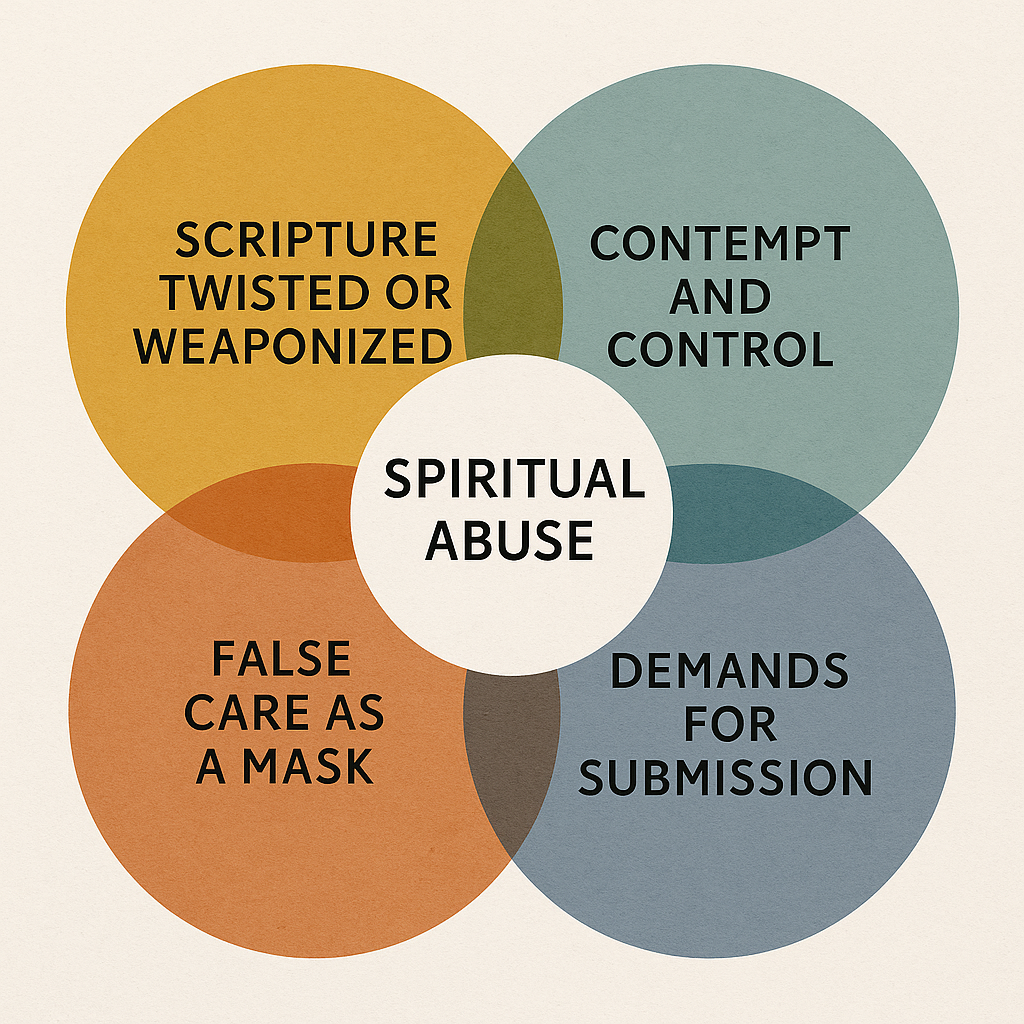
Sarah understands now that she was vulnerable — emotionally and spiritually open. What felt like care was, in her experience, mixed with control, blame, and fear.
She was blamed for the relationship’s problems. For being unforgiving. For noticing patterns. For trusting her instincts. Even as she grew stronger, she felt destabilized.
This was not simply a difficult relationship.
This was not a misunderstanding.
For Sarah, this was spiritual abuse.
How She Is Healing
Sarah is no longer in the relationship. Healing now looks like:
- Naming the abuse without minimizing it
- Separating God from the person who used His name
- Trusting Jesus directly, without fear or control
- Remembering who she is
- Releasing the fantasy that love or endurance could save someone unwilling to change
- Receiving community that does not use Scripture to dominate
She knows now:
The Spirit is not found in fear, shame, yelling, or condemnation.
The Spirit brings clarity, safety, and truth.
“Come to me, all who are weary and burdened, and I will give you rest.” — Matthew 11:28
That rest is what Sarah is walking toward now.
Postscript
To those still in it:
You are not crazy. You are not rebellious. You are waking up.
And to those who have made it out:
We carry each other forward — gently, honestly, without shame.
Just truth.
Just healing.
Just Jesus.
TOMFAW – Trusting Our Maker Finding A Way
Links to Related Scripture:
- Matthew 11:28 – Rest for the Weary
https://www.biblegateway.com/passage/?search=Matthew+11%3A28&version=NIV - Proverbs 3:5-6 – Trust in the Lord
https://www.biblegateway.com/passage/?search=Proverbs+3%3A5-6&version=NIV - Romans 8:28 – God Works for Good
https://www.biblegateway.com/passage/?search=Romans+8%3A28&version=NIV - Psalm 73 – The Prosperity of the Wicked
https://www.biblegateway.com/passage/?search=Psalm+73&version=NIV - 1 Peter 5:7 – Cast Your Anxiety on Him
https://www.biblegateway.com/passage/?search=1+Peter+5%3A7&version=NIV